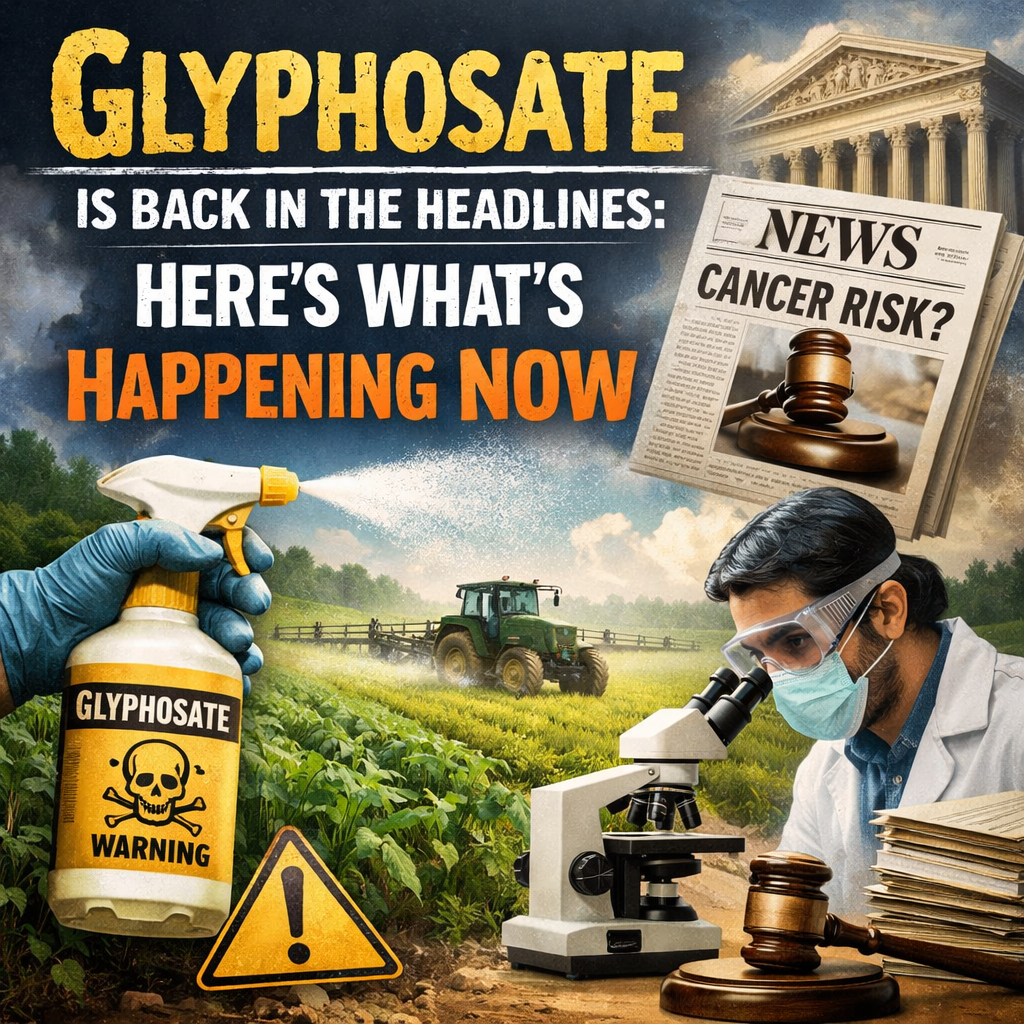
Glyphosate — the active ingredient in Roundup — is once again front and center in national news.
In 2026, the U.S. government moved to strengthen domestic production of glyphosate-based herbicides, while tens of thousands of lawsuits tied to Roundup are still active. At the same time, global health agencies remain divided on how to interpret long-term safety data.
If you’re hearing more about glyphosate lately, there’s a reason.
Here’s what’s actually happening.
What Is Glyphosate?
Glyphosate is a weed killer. It’s the main ingredient in Roundup, originally developed by Monsanto and now owned by Bayer.
It’s widely used in conventional agriculture, especially on crops that are engineered to tolerate it. It’s also used in landscaping, along roadsides, and in some residential settings.
Because it is so heavily used, trace amounts have been detected in soil, water, and certain food products.
The Latest U.S. Government Action
In February 2026, President Donald Trump issued an executive order under the Defense Production Act declaring glyphosate-based herbicides and key raw materials used to make them “critical” to national security and food supply stability.
The order directs federal agencies to prioritize domestic production and ensure supply chain stability.
Supporters argue this protects American farmers and prevents dependence on foreign suppliers. Critics argue it signals deeper federal commitment to a chemical that remains legally and scientifically controversial.
The bottom line: glyphosate continues to be supported at the federal level as an essential agricultural tool.
The Lawsuits: How Large Is the Legal Battle?
The legal fight over Roundup is one of the largest product liability cases in U.S. history.
Bayer has faced approximately 192,000 claims alleging that exposure to Roundup caused non-Hodgkin lymphoma (NHL).
As of recent reporting:
- Roughly 131,000 claims have been settled or resolved
- Approximately 60,000+ cases remain active
- In early 2026, Bayer proposed a multi-billion-dollar settlement (reported around $7+ billion) aimed at resolving a large portion of the remaining cases
Meanwhile, the Supreme Court of the United States is scheduled to hear arguments in 2026 in a case that could determine whether federal pesticide law overrides certain state-level failure-to-warn lawsuits.
The outcome could shape the future of Roundup litigation nationwide.
It’s important to note: settlements do not equal admission of causation. However, the sheer volume of claims has kept public concern high.
What Does the Research Say?
This is where things get complicated.
In 2015, the International Agency for Research on Cancer classified glyphosate as “probably carcinogenic to humans.”
That classification looks at whether something can cause cancer under certain circumstances.
However, other regulatory agencies that assess real-world exposure risk have reached different conclusions.
The United States Environmental Protection Agency (EPA) has stated glyphosate is unlikely to be carcinogenic at typical exposure levels.
The European Food Safety Authority (EFSA) and the European Chemicals Agency (ECHA) have also concluded that glyphosate does not meet criteria for classification as a carcinogen under their regulatory frameworks.
Similarly, Health Canada has stated it is unlikely to pose a cancer risk when used as approved.
At the same time, some studies and meta-analyses suggest higher occupational exposure may be associated with increased risk of non-Hodgkin lymphoma.
So the disagreement largely centers on:
- Hazard vs. real-world exposure risk
- Long-term cumulative exposure
- Differences between pure glyphosate and full commercial formulations
Did Europe Ban Glyphosate?
Despite widespread headlines in recent years, the European Union did not issue a full ban.
In 2023, the European Commission renewed glyphosate’s approval through December 2033. Individual countries can impose additional restrictions, but there is no EU-wide prohibition.
The debate in Europe remains politically active, but glyphosate is still legally approved at the EU level.
Why This Debate Continues
Glyphosate sits at the center of several competing forces:
- Industrial agriculture and global food production
- Cancer research and public health concerns
- Corporate liability and litigation
- Environmental exposure debates
- National supply chain security
For some, the lawsuits signal a serious safety issue.
For others, regulatory reviews suggest acceptable risk under approved use.
What’s clear is this: glyphosate is not disappearing from agriculture anytime soon — and the legal and scientific discussions around it are far from over.